
















.png)
Børge Mogensen’s Iconic Furniture And Enduring Design Legacy
Børge Mogensen occupies a special place in Danish furniture history. His designs are recognisable for their calm proportions, honest materials, and practical construction, yet they never feel cold or anonymous. A Mogensen chair or sofa is made to be used every day, to gather marks and memories, and to become more personal with time.
Born in Aalborg in 1914, Mogensen trained as a cabinetmaker before studying at the Danish School of Arts and Crafts in Copenhagen. He later worked with Kaare Klint, a formative influence who taught him to examine traditional furniture carefully and refine it for modern life. That combination of craft knowledge and functional thinking shaped nearly everything he designed.
Mogensen’s work is especially appealing to anyone who values gifts and objects with a story. His furniture belongs in a home rather than a showroom alone: a dining chair around a family table, a leather armchair beside a bookcase, or a sturdy storage piece holding treasured everyday things. His legacy offers a thoughtful way to understand why Danish modern design remains so influential.
From Cabinetmaker To Furniture Pioneer
Mogensen’s early cabinetmaking experience gave him a practical understanding of wood, joints, upholstery, and proportion. He knew how a piece was assembled because he had worked with the materials directly. This background separated him from designers who treated furniture primarily as a visual exercise.
At the Danish School of Arts and Crafts, he studied under Kaare Klint, often described as the father of modern Danish furniture design. Klint encouraged his students to analyse existing furniture types, measure the human body, and improve familiar forms instead of chasing novelty. Mogensen absorbed this method and developed a lifelong interest in straightforward, useful furniture.
His approach was also socially minded. He wanted well-made furniture to be accessible, durable, and suitable for ordinary homes. The idea of creating “building furniture” — pieces that could be combined, adapted, and expanded — became central to his practice. This is one reason his work feels so relevant today, when many people are looking for fewer, better objects.
The Hunting Chair And The Beauty Of Structure
The Hunting Chair, introduced in 1950, was one of Mogensen’s earliest major successes. Its low seat, broad leather panels, and visible brass buckles give it a distinctive character, while the solid oak frame provides a reassuring sense of stability. The design was inspired by traditional Spanish and North African seating, interpreted through a Danish modern lens.
The chair’s leather is designed to develop a rich patina. Small changes in colour, softening at the edges, and signs of use become part of its visual identity rather than flaws to hide. This relationship between furniture and time is fundamental to Mogensen’s design philosophy. The object gains warmth through ownership.
The Hunting Chair also demonstrates his interest in construction as decoration. Straps, buckles, and exposed connections are visible and purposeful. There is little unnecessary ornament because the materials and the way they work together provide all the detail needed. It is a strong choice for a reading corner, although its compact form can also work beautifully in a bedroom or hallway.
The Spanish Chair And Open-Plan Living
Mogensen developed the Spanish Chair in 1958 after encountering traditional chairs with wide armrests during a trip through Spain. The broad arms are more than a dramatic feature: they provide a convenient surface for a glass, book, or cup of coffee. This small practical gesture makes the chair feel unusually generous.
The chair is typically made from solid oak or beech with thick saddle leather. Its frame is clean and architectural, while the leather introduces softness and a tactile quality. Over time, the seat and back become more supple, creating a chair that looks increasingly comfortable as it ages.
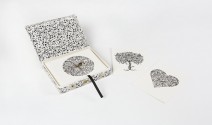
The Spanish Chair was designed for relaxed modern living, particularly the open-plan interiors becoming popular in the mid-twentieth century. It can define a quiet zone without visually closing it off. In a contemporary Copenhagen apartment, it pairs naturally with pale timber, textured wool, ceramics, and simple lighting. For a smaller gift inspired by this sensibility, tactile paper goods such as illustrated notecards can bring the same appreciation for craft and everyday beauty to a desk.
Comparing The Signatures Of Mogensen’s Collection
Several of Mogensen’s best-known pieces share a visual language, but each answers a different domestic need. The Hunting Chair is intimate and sculptural, the Spanish Chair is expansive and sociable, and the J39 focuses on simplicity and versatility. Looking at them together makes his design decisions easier to understand.
| Piece | Year introduced | Defining materials | Best suited to | Design character |
|---|---|---|---|---|
| Hunting Chair | 1950 | Oak, saddle leather, brass buckles | Reading corners and bedrooms | Low, tactile, expressive |
| Spanish Chair | 1958 | Solid wood and thick leather | Lounges and open-plan rooms | Broad, relaxed, architectural |
| J39 People’s Chair | 1947 | Solid wood and woven paper cord | Dining areas and desks | Light, democratic, versatile |
| Fredericia J41 Chair | 1944 | Painted or natural wood | Dining tables and workspaces | Vertical, spare, elegant |
| BM63 Deck Chair | 1960s | Wood and canvas or leather | Terraces and informal seating | Foldable, relaxed, outdoor-minded |
The J39 People’s Chair is perhaps the clearest expression of Mogensen’s democratic ambitions. Designed in 1947, it has a simple wooden frame, a woven paper-cord seat, and a shape that works in many settings. It is sometimes called the People’s Chair because it was conceived as a good, affordable chair for everyday use.
Its apparent simplicity requires considerable precision. The angle of the back, the curve of the rails, and the tension of the woven seat all contribute to comfort. Nothing is exaggerated, so small changes in proportion matter. Around a dining table, the J39 creates a balanced, welcoming setting without dominating the room.
Furniture For Flexible Everyday Life
Mogensen’s storage designs reveal another side of his practice. His modular systems were created to respond to changing homes and changing collections of belongings. Rather than treating storage as something to conceal at all costs, he made shelves, cabinets, and drawers into orderly architectural elements.
The Øresund series, designed in the 1950s, is a notable example. It combines cupboards, shelving, and drawers in a way that allows users to build a configuration suited to their space. The design is restrained, but its flexibility gives it a lasting usefulness. A cabinet can hold books, tableware, textiles, or objects collected during travel.
This emphasis on adaptability is valuable in smaller homes, where every piece has to work hard. A well-designed storage unit can divide a room, display ceramics, organise a work area, and provide a visual anchor. Mogensen’s furniture avoids the disposable feeling of fast interiors because it is meant to change with the life around it.
His approach also makes individual pieces meaningful gifts for a new home. A substantial chair may be beyond an ordinary gift budget, but the principles behind it can guide smaller choices: a wooden tray, a well-made notebook, a woven basket, or a beautifully crafted object that is useful without being impersonal.
Materials That Improve With Age
Wood and leather are central to Mogensen’s appeal. He favoured oak, beech, and other honest materials whose grain and texture remain visible. Rather than covering the frame with elaborate finishes, his designs allow the material to communicate its own qualities.
Leather plays a particularly important role in the Hunting Chair and Spanish Chair. It begins with a firm, substantial feel and gradually softens through use. Exposure to light changes its tone, while contact creates subtle variations across the surface. This ageing process means that two older examples of the same design may look quite different.
Paper cord, used in the J39 and other Danish chairs, offers a different kind of durability. The woven seat is light in appearance but remarkably resilient when properly maintained. It brings a quiet texture to a dining room and complements both rustic and refined interiors. The contrast between a smooth wooden frame and a hand-woven surface is one of the details that keeps the chair from feeling austere.
Care should be considered part of ownership. Wood benefits from gentle cleaning and suitable oil or soap, depending on its finish. Leather should be dusted regularly and treated with products appropriate to its type. Paper-cord seats need protection from unnecessary moisture. Proper care does not preserve a piece in an untouched state; it helps the materials age gracefully.
Choosing A Mogensen-Inspired Piece
A genuine vintage design by Mogensen can be a significant investment, and condition matters greatly. Look for clear provenance, recognisable construction details, manufacturer markings, and upholstery or cord that has been assessed honestly. Restored pieces can be excellent, but the nature of the restoration should be documented.
For first-time buyers, the J39 is often the most flexible choice. It works as a dining chair, desk chair, occasional seat, or extra chair for guests. The Spanish Chair makes a stronger statement and needs more visual and physical space, while the Hunting Chair suits someone who appreciates a lower, more enveloping seat.
Mogensen’s designs can also inspire a broader gift selection without requiring a major purchase. Choose objects that share his respect for function, tactility, and lasting materials.
- Select a wooden or leather item that will develop character through use.
- Look for practical forms with visible craftsmanship rather than excessive decoration.
- Match the scale of the gift to the recipient’s home and daily routines.
- Choose neutral, natural colours that can work with changing interiors.
- Include information about the designer or maker so the object carries a story.
The most successful Mogensen pieces are those that become part of a rhythm: breakfast at the dining table, a quiet hour with a book, or an evening spent talking with friends. Their beauty is tied to these moments, not separated from them.
Why His Designs Still Matter
Mogensen’s furniture continues to feel current because it addresses permanent human needs. People still want chairs that support the body, storage that adapts to possessions, and materials that become more beautiful through use. The visual language is recognisably mid-century, but the underlying ideas are not bound to a particular decade.
His work also offers an alternative to constantly changing trends. A Mogensen chair can sit comfortably beside contemporary art, vintage textiles, Scandinavian ceramics, or a more eclectic collection of objects. It does not demand a perfectly coordinated interior. Its quiet confidence allows other things to have a place.
From Copenhagen, this design tradition is easy to encounter in homes, showrooms, museums, and carefully edited interiors. Yet its strongest lesson is universal: thoughtful design does not need to be loud to be memorable. It can show its quality through proportion, material, and the way it supports ordinary life.
Bring that spirit into a home by choosing one enduring object with care, whether it is an original Børge Mogensen chair, a well-made piece of storage, or a small crafted gift inspired by Danish simplicity. Explore his iconic furniture with an eye for use, texture, and longevity, and let the right piece gather its own story over time.