












.png)
Liv Strömquist's Zines: Feminist Comics with a Scandinavian Edge
Liv Strömquist has spent more than two decades turning the comic page into a feminist battleground, and her zines remain some of the most beloved artefacts of European independent comics. Her work sits at the crossroads of personal essay, cultural critique and visual storytelling, with subjects ranging from the history of the clitoris to the cult of the beauty industry. For readers in Melbourne, Sydney or Perth who follow the local zine fair circuit, her name carries a particular kind of weight: she is often cited as the artist who made it acceptable to be furious, funny and visually ambitious in the same breath.
The appeal of her work for a gifting blog is straightforward. A Strömquist zine is compact, affordable and visually arresting, which makes it an unusually generous present. It also travels well across borders, and Australian readers will find that her observations about shame, capitalism and reproductive politics land with surprising force in a local context. Whether tucked into a stocking or paired with a coffee table book, her zines feel less like reading material and more like a small manifesto you can hand to a friend.
The Origins of a Comic Provocateur
Liv Strömquist was born in Stockholm in 1978 and began publishing comics while still a teenager, contributing to Swedish underground magazines before founding her own imprint, Jeansen Pub, in the early 2000s. The name became a kind of banner for a generation of Nordic cartoonists who treated the zine format as a serious artistic medium rather than a teenage hobby. Strömquist's early work already displayed the hallmarks that would define her career: dense blocks of text interwoven with deceptively simple drawings, footnotes that read like academic arguments, and a tone that swings between scholarly detachment and savage wit.
Her decision to remain rooted in the zine world, even as her books were translated into more than a dozen languages, says something about her artistic priorities. Zines are disposable by design, and that disposability is part of their honesty. They can be produced quickly, distributed through alternative bookshops and read in a single sitting. For an artist whose subject matter often involves the urgency of contemporary debate, that immediacy matters. In an era when independent publishers in Adelaide and Brisbane are rediscovering the value of small print runs, her example feels especially relevant.
From Zine Stands to Bookshelves
The leap from photocopied zine to internationally published graphic novel happened gradually for Strömquist, and the trajectory is worth tracing for anyone interested in how underground comics cross into the mainstream. Her breakthrough book, "The Fruit of Knowledge", collected several years of zine work into a single volume about the medical establishment's persistent disinterest in female pleasure. The book was picked up by Text Publishing for the Australian market, where it has become a quiet fixture in feminist sections of independent bookshops from Newtown to Fitzroy.
A similar path followed "I'm Every Woman", which examined the cultural pressure on women to embody impossible archetypes. Australian readers who encountered Strömquist through these translations often went back to hunt for the original zines, treating them as the raw material of a now-canonical body of work. The zines themselves, with their stapled spines and high-contrast printing, retain a tactile pleasure that the collected editions cannot quite replicate.
Works to start with:
- The Fruit of Knowledge for a crash course in feminist science history
- I'm Every Woman for a sharp look at beauty mythology
- The Night Guest for a quieter, more personal register
- Prins Charles Känsla for her signature essay-comic hybrid form
Anatomy of a Strömquist Zine
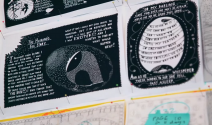
A typical Strömquist zine runs somewhere between sixteen and thirty-two pages, printed in black and white with a single colour accent on the cover. The art style is deliberately flat, almost childlike, which creates a jarring contrast with the sophistication of the arguments on the page. She draws faces with the same economy as a 1970s editorial cartoonist, but fills her panels with footnotes, quotations and statistical citations that would feel at home in a sociology journal. The result is a reading experience that asks you to slow down, even when the subject matter is urgent.
Her scripts are built around recurring rhetorical moves. She introduces a concept, often drawn from feminist theory or queer studies, then unpacks it through a mixture of personal reflection and historical anecdote. A page might pivot from a 1950s etiquette manual to a contemporary tweet without warning, and that collision is the joke and the argument. For Australians used to the dry humour of local cartoonists like First Dog on the Moon, the sensibility is familiar even when the references are decidedly Scandinavian.
Themes That Resonate with Australian Readers
Strömquist's fixation on shame, particularly the gendered variety, travels surprisingly well across hemispheres. In a country where conversations about consent, body image and reproductive rights have dominated public life for the past decade, her zines feel less like foreign artefacts and more like dispatches from a parallel debate. Australian readers will recognise the advertising tropes she skewers, the language of self-improvement she dismantles, and the rituals of beauty work that she traces back to Victorian anxieties.
Her later work has expanded into environmental critique and the politics of monogamy, both topics that have found receptive audiences at zine fairs in Collingwood, Fremantle and Fortitude Valley. The Australian summer of recent years, with its record-breaking bushfire warnings and renewed conversations about climate grief, gave her environmental comics a particular urgency. Local librarians at the State Library of Victoria have reported increased interest in Nordic feminist comics during this period, often from readers who began with Strömquist and moved outward to local practitioners such as Ailsa Wild.
Collecting Her Zines as Gifts
A Strömquist zine makes an unusually thoughtful gift because it combines intellectual weight with a certain punk sensibility. It signals that you take the recipient seriously enough to give them something challenging, but light enough to be read on a tram ride from Brunswick to the city. The price point is generally gentle, and the format is forgiving: even a coffee-stained copy retains its argumentative power. For Australians shopping at independent retailers like Readings or Better Read Than Dead, her zines often sit alongside the work of Australian counterparts such as the collective behind the Kingfisher zine.
The collecting instinct, once it takes hold, becomes a small obsession. Early Strömquist zines from the Jeansen Pub era now command respectable prices on the secondary market, and complete runs are notoriously difficult to assemble. Gifts of newer zines carry a particular generosity: you are handing someone a piece of a living artistic conversation, not a museum piece. Some Australian collectors focus on specific themes, building little libraries around her work on shame, or her collaborations with Swedish illustrators who share her flat-line aesthetic.
Where to Find Strömquist in Australia
The most reliable route to Strömquist's zines in Australia runs through specialist distributors rather than mainstream retailers. The good news is that the local network is healthier than it has ever been.
Stockists and events worth checking:
- The Comic Lounge in Melbourne's CBD stocks a rotating selection of translated zines, often imported directly from Stockholm
- Kinokuniya in Sydney carries her graphic novels and occasionally stocks English-language zines from European distributors
- The Brisbane zine fair at the Judith Wright Centre features tables selling her work alongside local artists
- Readings in Carlton has been known to special-order back catalogue titles for dedicated readers willing to wait
For those who prefer to support local stockists first, it is worth emailing ahead before making a special trip, since zine availability can be unpredictable and the more obscure titles come in small print runs. Australian readers can also order directly from European publishers who ship internationally, though postage costs tend to flatten the price advantage of the format.
Pairing Zines with Other Thoughtful Gifts
A Strömquist zine is rarely the only thing in a good gift bag. It pairs beautifully with a small notebook, a set of fine pens or a bundle of postcards from Australian women cartoonists. For a friend's birthday in Surry Hills or a housewarming in Brunswick, a zine tucked into a stack of vintage comics feels both personal and politically resonant. Some gifters wrap the zine in brown kraft paper and write a single line of dedication on the cover, a gesture that echoes the handmade ethos of the medium itself.
For something slightly more playful, consider pairing the zine with LEGO gift wrap techniques, which turn the act of unwrapping into a small creative project. The contrast between the seriousness of the comic's content and the toy-like packaging can be its own kind of joke, one that Strömquist herself would probably appreciate. A small clutch of zines, a notebook and a set of coloured pencils makes a tidy gift for a teenager just discovering feminist criticism, or for a friend who has everything except a new way of seeing.
If you are browsing for a gift that combines visual punch with genuine intellectual substance, Liv Strömquist's zines are difficult to beat. They are affordable, portable and quietly radical, and they reward the kind of close reading that has all but disappeared from mainstream comics. Order one for a friend who collects independent work, leave a stack at the next housewarming you attend, or simply treat yourself to a copy and see what conversations it sparks over your next flat white in Melbourne. The zine shelf of any thoughtful gift-giver is incomplete without at least one Strömquist in the mix.