












.png)
Maja Hvid’s ocean-inspired bowls and the art of quiet movement
A profile of Danish glassblower Maja Hvid’s ocean-inspired bowls begins with a simple pleasure: the way a rounded vessel catches light and briefly resembles a small horizon. Hvid’s bowls do not reproduce waves as surface decoration. Their character comes from quieter cues, including wavering rims, translucent colour and the sense that each form was shaped by a moving hand.
Seen through a Copenhagen lens, the work feels intimate rather than monumental. Copenhagen’s appetite for useful objects with a distinct material presence gives Maja Hvid’s bowls a natural setting. Their references to shore, water and changing weather connect them to that northern environment without turning them into coastal souvenirs.
For Australian readers, these vessels are equally appealing as collectible design pieces and objects for everyday life. Their visual character is easy to appreciate, while questions of food safety, shipping and pairing with existing tableware deserve attention. A considered purchase starts by looking closely at the maker, the individual bowl and the life it is likely to enter.
A horizon caught in glass
The strongest quality of Maja Hvid’s bowls is their sense of arrested movement. A curve lifts, tapers or settles in a way that makes a static object feel briefly liquid. Some pieces resemble a bowl of water seen from above; others suggest a wave folding back on itself. The resemblance is suggested rather than illustrated, allowing the actual glass to remain the focus.
Hvid’s palette works in the same restrained way. Clear areas can move into sea green, smoky grey, blue or soft mineral tones, with colour gathering unevenly around the form. Light passes through these variations and changes their depth. Against timber or stone, the glass looks lively; against white walls, its edges and irregularities become more pronounced.
That balance of volume and delicacy is what gives the bowls a lasting place in an interior. They can read as sculptural objects when empty, then become functional companions when used. The ocean reference remains present, but it supports daily rituals rather than dictating them. This is a useful lesson from Scandinavian design: atmosphere works best when it is woven into usefulness.
The hand behind the horizon
Glassblowing gives Maja Hvid’s work an evidence of process that machine production cannot imitate. Slight changes in wall thickness, softened edges, small bubbles and asymmetry can reveal the rhythm of making. Marks on the base and variations between rims are part of the object’s biography, not defects to be disguised in a catalogue image.
The artist’s approach appears especially clear in the way the bowls hold their shape. Their silhouettes remain simple enough to feel calm, yet no two seem governed by a mechanical template. This individuality rewards close viewing and makes online photographs only a starting point. Colour can shift by screen, room and time of day, so details from the studio or seller are worth comparing with your own space.
For collectors, that individuality creates a different kind of value. There is no exact duplicate to replace a damaged piece, and the apparent rarity comes from the act of making rather than a deliberately numbered edition. It is better to select one bowl whose proportions and colour speak to you than to chase a matching set. Maja Hvid’s work is strongest when understood as a relationship between a person, a material and a particular moment.
From a Danish coast to Australian tables
The Danish reference translates especially well into Australian homes, where bright daylight, open windows and frequent use of the dining room can reveal the full colour of handmade glass. In Sydney, a cool blue bowl may sit against pale timber in a light-filled apartment; in Melbourne, its smoky tone can echo brick, concrete and evergreen. The same piece changes with the architecture around it.
The country’s design market also has many places where this kind of object can be encountered away from a web shop. Weekend traders such as Paddy’s Markets in Sydney and the Rose Street Artists’ Market in Melbourne feature local ceramicists, small labels and imported homewares side by side. Such stalls provide context for craft and help buyers judge texture and scale in person, even when the Maja Hvid bowl itself is available online.
Australian gifting habits add another layer. Christmas falls in summer, and many hosts use bowls for long lunches, casual dinners and fruit rather than for a formal winter table. Housewarmings, birthdays and wedding registries also create practical moments to choose glass. A bowl chosen for how it will be used, rather than how prominently it will sit on a shelf, tends to form the stronger connection.
Choosing a bowl as a gift
A Maja Hvid bowl suits a recipient who notices material and shape, yet it does not need to belong to a collector. It can be offered for a new home, a birthday or simply as a gift that says the giver has considered the recipient’s daily surroundings. A note about the ocean inspiration and the handblown character adds context without turning the object into a grand claim.
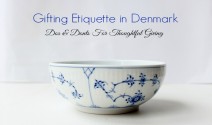
For a home that already contains plain mugs and bowls, the restrained forms in minimalist Danish stoneware offer a useful comparison. A translucent bowl can sit comfortably beside matte stoneware, creating contrast through texture rather than through loud pattern. It also helps to remember that a functional gift should fit the recipient’s habits, including whether they prefer open shelving or a calm, uncluttered cabinet.
Budget and availability deserve equal attention. Handblown work has natural variation, and a one-off bowl may not match the colour shown in an earlier photograph. Check the maker’s current stock and any authorised seller, compare dimensions with a bowl already at home, and look for information about whether the piece is intended for food use. Clear expectations make a beautiful, fragile object easier to give.
Living with and caring for the glass
Before a bowl becomes part of a daily routine, confirm how the artist recommends using it. Decorative and food-safe are not interchangeable descriptions. If a piece is intended for food, wash it by hand with mild detergent and avoid sudden temperature changes, which can stress glass. A dishwasher should be used only when the maker specifically permits it.
Display deserves a little planning too. Leave enough room for the profile to be seen, especially if colour changes around the rim. A side table, open shelf or dining-room cabinet can show the work without crowding it. Because handmade glass may be top-heavy or asymmetrical, stable storage matters; keep pieces away from edges, busy doors and spots where they could be knocked by a child or pet.
Long-distance delivery is part of the ownership story in Australia. Ask how the bowl is protected, whether insurance is available and who is responsible if it arrives damaged. Keep the original wrapping if the piece will be stored or transported, and photograph the unboxing. Thoughtful packing protects more than the object: it preserves the giver’s intention all the way to the recipient.
Buying with patience and purpose
Buy from Maja Hvid directly or a reputable seller with clear photographs, dimensions and provenance. It is useful to ask whether a particular bowl is current stock, a studio sample or a one-off piece, since that can affect colour, dimensions and availability. The artist’s own descriptions should take priority over a reseller’s broad label of “decorative glass”, especially if serving food is likely.
That principle is echoed in this Dutch reflection on honest bonus use, where a reward has value only when it supports a real intention. The same restraint applies to buying handmade objects. A single bowl chosen for its relationship with the recipient’s home can carry more meaning than several attractive additions bought simply because they are available.
Australian consumer law provides a useful floor for the transaction. Under the Australian Consumer Law, goods sold in Australia must meet promises made about them and generally be of acceptable quality. For glass used with food, importers and sellers should also confirm that relevant Food Standards Australia and New Zealand requirements apply. Decorative pieces may fall outside food-contact expectations, so ask for clear guidance rather than assuming every glass bowl is suitable for serving.
Choose a Maja Hvid bowl for the way it catches light, echoes a shoreline and settles naturally into a room. Follow The Orange Gift Bag for more thoughtful Danish design stories, check the maker’s latest details before ordering, and give the piece a place where its hand and movement can be appreciated every day.